Saprotrophic Fungi in Peat-Based Growing Media: Causes, Identification and Prevention
The appearance of white fungal mycelium, yellow mushrooms or other fungal structures in peat-based growing media is a relatively common phenomenon in professional horticulture. Although their presence often raises concerns among greenhouse growers, nursery operators and substrate distributors, these fungi do not necessarily represent a plant disease or a defect in the growing medium.
In most cases, these organisms are saprotrophic fungi — naturally occurring microorganisms that obtain nutrients by decomposing organic matter rather than attacking living plant tissue.
Understanding their biological characteristics, environmental requirements and potential influence on substrate performance is essential for maintaining consistent crop quality and successful commercial plant production.
1. What Are Saprotrophic Fungi?
Saprotrophic fungi, also commonly referred to as saprophytic fungi, are organisms that obtain energy and nutrients from dead or decomposing organic material.
In natural ecosystems, they play an important role in organic matter decomposition, nutrient recycling and the biological transformation of plant residues.
Professional horticultural growing media frequently contain organic materials capable of supporting fungal development, including:
- Sphagnum peat moss;
- Composted bark;
- Coconut coir;
- Wood fiber;
- Wood chips;
- Green compost;
- Other organic substrate components.
Unlike plant pathogens, most saprotrophic fungi do not require a living host plant to complete their life cycle.
However, under favorable environmental conditions, their development can become excessive and negatively influence the physical properties of growing media, irrigation efficiency and the commercial appearance of cultivated plants.
2. Why Do Fungi Develop in Peat-Based Growing Media?
Peat moss is a natural organic material. Although high-quality horticultural peat is processed under controlled conditions, it should not be considered a sterile growing medium.
Fungal spores are widely distributed throughout the natural environment and may enter the production chain during raw material extraction, substrate manufacturing, transportation, storage or plant cultivation.
The presence of fungal spores does not necessarily result in visible fungal growth. Spores and microscopic fungal structures may remain inactive or develop slowly for extended periods.
Visible fungal development depends on several environmental factors.
Moisture and irrigation
Prolonged moisture in the growing medium, excessive irrigation and insufficient drainage create favorable conditions for many saprotrophic fungi.
Some species may also benefit from repeated fluctuations between excessively dry and wet substrate conditions.
Maintaining a consistent, crop-specific moisture regime is therefore important for controlling fungal development.
Temperature
Many fungi associated with horticultural substrates develop actively under warm growing conditions. Temperatures between approximately 20°C and 28°C (68–82°F) can stimulate the development of certain common species when sufficient moisture and organic nutrients are available.
However, optimal temperatures vary between fungal species.
Air circulation and greenhouse humidity
Insufficient ventilation, high relative humidity and reduced evaporation from the substrate surface may encourage fungal colonization.
These conditions frequently occur during periods of cloudy weather, seasonal changes and intensive greenhouse production.
Organic substrate composition
Different organic materials provide different nutrient sources for microorganisms.
Substrates containing wood fiber, bark, compost or other relatively biodegradable organic components may support different fungal populations compared with traditional sphagnum peat-based formulations.
The biological stability of individual components, their processing methods and their proportions within the growing medium can influence the likelihood of excessive fungal development.
3. The Most Common Saprotrophic Fungi in Horticultural Substrates
Several fungal genera are frequently associated with commercial growing media and ornamental plant production.
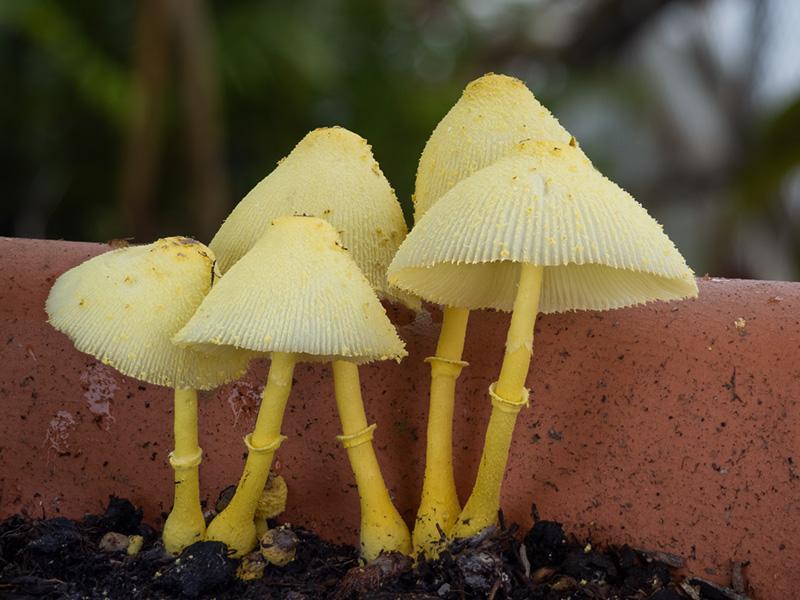
Leucocoprinus birnbaumii — Yellow Flowerpot Mushroom
Leucocoprinus birnbaumii is one of the most recognizable mushroom-forming fungi encountered in greenhouses, nurseries and indoor potted plants.
It is commonly known as the yellow flowerpot mushroom, yellow parasol or yellow houseplant mushroom.
Typical characteristics include:
- Bright yellow or pale yellow mushrooms;
- White or yellowish fungal structures within the substrate;
- Small mushrooms growing individually or in clusters;
- Extensive development of mycelium beneath the substrate surface.
The fungus has been observed in numerous ornamental plant cultures, including orchids, anthuriums, ficus, zamioculcas, succulents and tropical foliage plants.
Although it generally does not infect living plant tissues, extensive mycelial development can interfere with water distribution within the root zone.
The mushrooms should not be consumed and should be kept away from children and pets.
Peziza Species — Cup Fungi
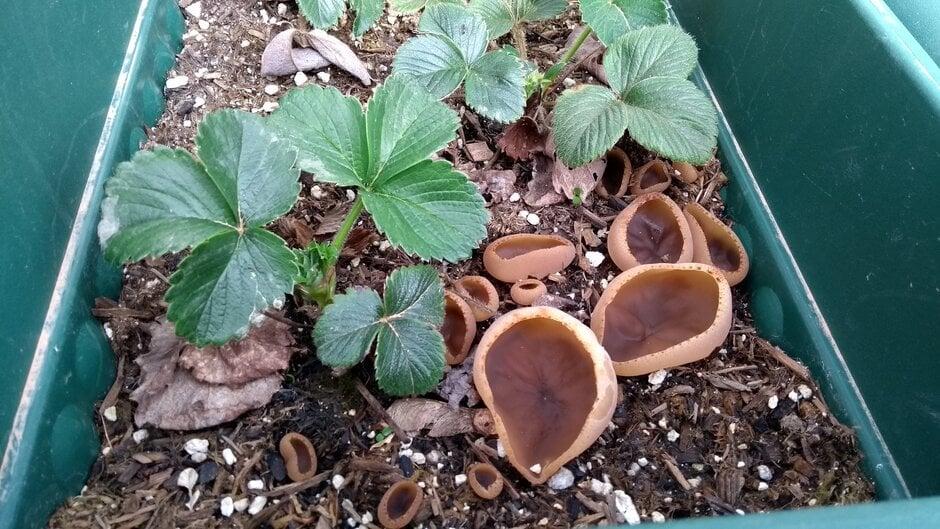
Fungi belonging to the genus Peziza can develop distinctive cup-shaped or bowl-shaped reproductive structures on the surface of growing media.
Their coloration varies depending on the species and stage of development.
Peziza species may occur in peat-based substrates, compost, wood-containing growing media and other organic materials.
Their presence is generally associated with organic matter decomposition and favorable moisture conditions.
Although they are typically not direct plant pathogens, their visible development can reduce the commercial attractiveness of potted plants and indicate environmental conditions that require attention.
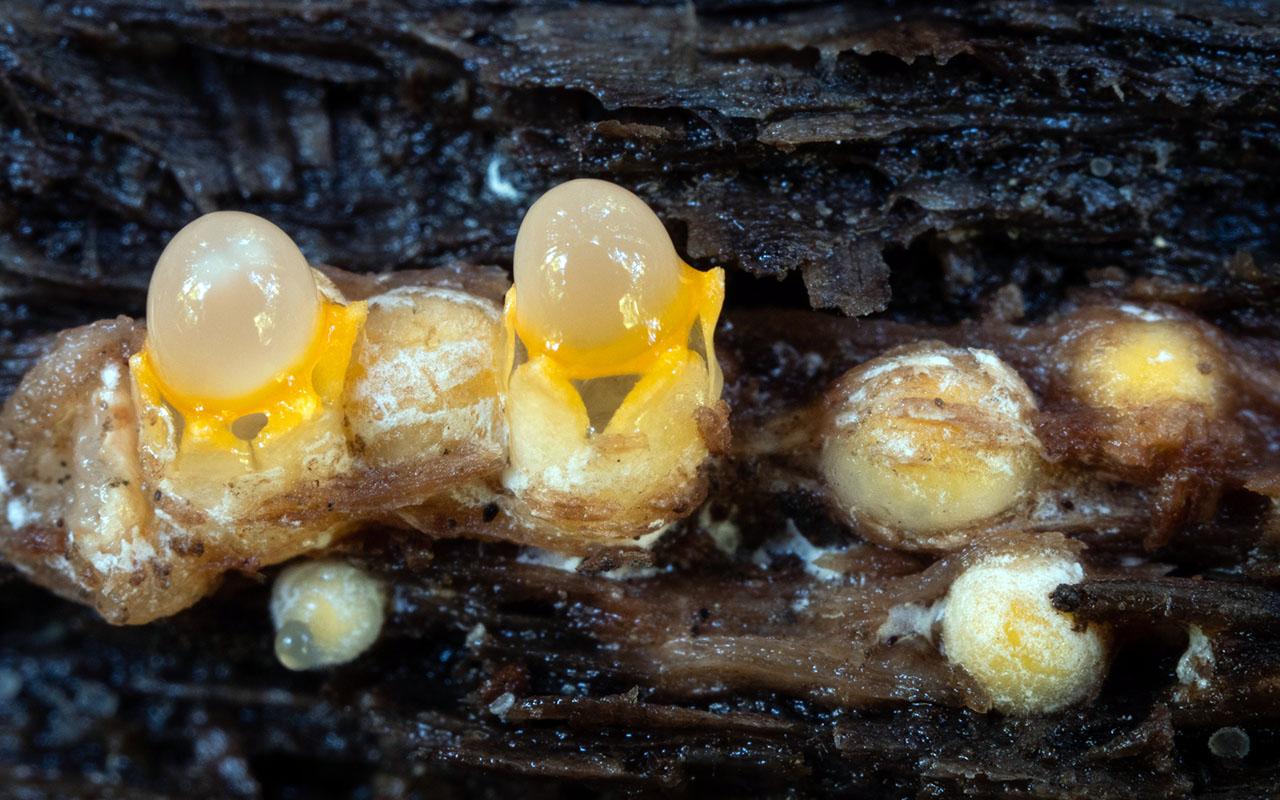
Sphaerobolus Species — Artillery Fungi
Sphaerobolus, commonly known as artillery fungus, is particularly associated with decomposing wood and other organic materials.
This fungus has an unusual method of spore distribution. Its reproductive structures can forcibly discharge small, dark spore packets over distances of up to approximately six meters (20 feet).
These sticky spore packets can attach to:
- Plant leaves;
- Containers;
- Greenhouse structures;
- Benches;
- Equipment;
- Other surrounding surfaces.
Once attached, they can be extremely difficult to remove.
In commercial ornamental production, artillery fungi primarily represent a cosmetic and hygiene problem rather than a direct plant disease.
properties throughout cultivation is equally important.
Athelia turficola
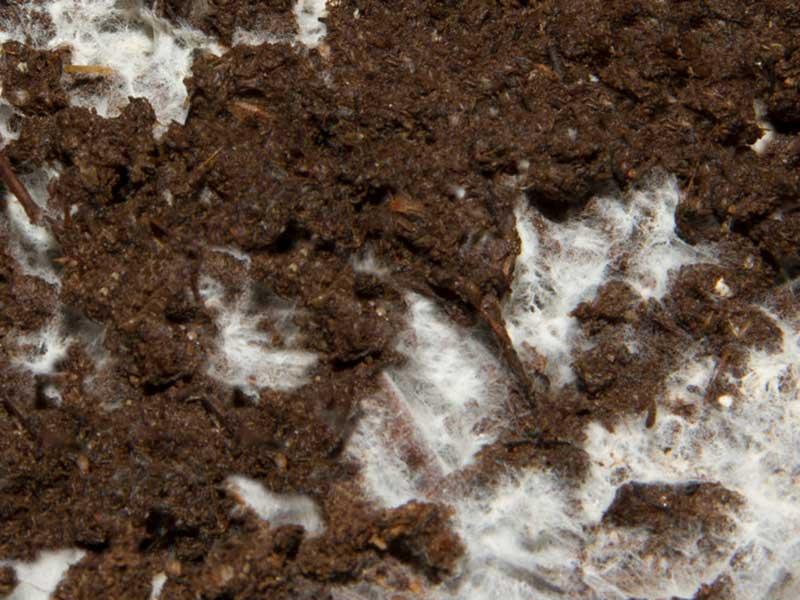
Athelia turficola is another fungus associated with organic horticultural substrates, including peat-based growing media.
Its visible structures are generally white to cream-colored and may develop across the substrate surface or around organic particles.
Its appearance can sometimes be confused with other fungal species. Accurate identification may therefore require laboratory examination.
Although commonly associated with organic matter decomposition, its biological behavior can vary. It should not automatically be assumed that every unidentified white fungal growth is harmless.
4. Can Saprotrophic Fungi Damage Plants?
The distinction between direct and indirect plant damage is particularly important in professional horticulture.
Most saprotrophic fungi do not directly attack healthy roots, stems or leaves. Their primary nutrient source is nonliving organic matter.
Nevertheless, excessive fungal growth can negatively affect plant development through changes in the physical and biological conditions of the growing medium.
Potential problems include:
- Reduced substrate wettability;
- Uneven moisture distribution;
- Restricted water penetration;
- Localized dry areas within containers;
- Changes in nutrient availability;
- Irregular plant development;
- Reduced commercial quality of ornamental plants.
Under severe conditions, these indirect effects may cause substantial economic losses, even without direct infection of plant tissues.
5. Fungal Mycelium and Water Repellency in Growing Media
One of the most significant problems associated with excessive fungal development is the formation of water-repellent zones within the substrate.
Fungal mycelium consists of microscopic thread-like structures known as hyphae. These structures can spread throughout the growing medium and, in some cases, form dense networks around organic substrate particles.
Certain fungi produce hydrophobic substances that reduce the ability of water to penetrate the affected material.
Consequently, irrigation water may follow preferential channels instead of being distributed evenly throughout the container.
A grower may observe water draining rapidly from the bottom of a pot while significant portions of the root zone remain insufficiently hydrated.
Increasing irrigation volume alone may not solve the problem. It can create excessive moisture in unaffected areas while the hydrophobic sections remain relatively dry.
Water repellency can also occur when peat-based growing media become excessively dry, even in the absence of fungal colonization.
It is therefore important to determine whether the problem originates from fungal development, excessive substrate drying, irrigation practices or a combination of these factors.
Proper substrate selection, effective wetting agents and controlled irrigation management are important tools for maintaining uniform water distribution.
6. How Do Saprotrophic Fungi Spread in Greenhouses?
Fungal spores and viable mycelium can spread through several pathways within commercial horticultural operations.
Potential sources include incoming plant material, organic substrate components, airborne spores, contaminated containers, plant residues, irrigation runoff and growing equipment.
Fungal development may also originate from microorganisms already present within the greenhouse from previous production cycles.
Because fungal spores are widespread in the environment, identifying the exact source of colonization can be difficult.
The appearance of mushrooms several weeks or months after planting is not sufficient evidence that the original growing medium was the source of the problem.
A proper investigation should consider the entire production chain, including changes in irrigation, temperature, storage, substrate composition and greenhouse hygiene.
7. Saprotrophic Fungi During Substrate Storage and Transportation
Visible fungal development can occasionally occur inside bags, compressed bales or large packages of professional growing media.
Warm temperatures, prolonged storage and moisture accumulation inside packaging can stimulate fungal activity.
The risk may increase during summer transportation or when packaged substrates are stored in warm, humid warehouses.
Before using growing media containing visible fungal structures, growers should assess the extent of colonization, substrate odor, moisture distribution and physical condition.
In cases of limited saprotrophic growth, loosening and aerating the substrate may help suppress visible mycelial development.
However, heavily colonized growing media should be evaluated before use, especially for sensitive applications such as seed germination, rooting of cuttings and young plant propagation.
Where necessary, laboratory testing and small-scale plant trials can help determine whether the growing medium remains suitable for its intended application.
8. Prevention and Management in Professional Horticulture
Preventing excessive fungal development is generally more effective than attempting to eliminate established fungal populations.
Select an appropriate growing medium
Choose substrate formulations according to crop requirements, irrigation systems, growing conditions and expected production duration.
Consider the biological stability of organic components together with their water-holding capacity, air-filled porosity, structural stability and nutrient characteristics.
Optimize irrigation management
Avoid unnecessary irrigation during periods of low evapotranspiration.
Monitor moisture levels throughout the root zone rather than relying exclusively on the appearance of the substrate surface.
Maintain adequate drainage while avoiding excessive drying.
Improve greenhouse ventilation
Proper air movement helps regulate humidity and supports controlled drying of the substrate surface.
Adjust irrigation frequency and greenhouse climate management during prolonged periods of cloudy or humid weather.
Maintain professional hygiene standards
Regular cleaning of potting machines, benches, floors, containers, tools and irrigation systems can reduce the movement of fungal material between production areas.
Heavily affected plants should be isolated and, when necessary, removed from the growing area to minimize further distribution.
Store growing media correctly
Protect packaged substrates from excessive heat, direct sunlight, rain and physical damage.
Use older inventory first and avoid unnecessarily prolonged storage.
Follow the substrate manufacturer’s storage and handling recommendations.
Investigate persistent problems
When fungal development repeatedly occurs within a particular crop, greenhouse section or substrate formulation, review production records and compare affected plants with unaffected batches.
A systematic investigation is more useful than applying chemical treatments without identifying the underlying cause.
9. Laboratory Identification and Treatment
Visual observation can provide an initial indication of the fungal genus, but reliable species identification may require microscopic examination or molecular diagnostic methods, including DNA-based analysis.
Representative samples should be collected from several affected containers or substrate locations because fungal colonization is not always uniformly distributed.
It is also important to distinguish saprotrophic fungi from pathogenic organisms capable of causing root rot, damping-off or other plant diseases.
Routine fungicide application is not recommended solely because mushrooms or fungal mycelium are visible.
Chemical treatments may have limited effectiveness against established fungal colonies and can influence other microorganisms within the growing medium.
Any chemical or biological treatment should be selected according to the identified organism, crop sensitivity, local registration requirements and professional recommendations.
10. The Importance of High-Quality Sphagnum Peat Moss
Sphagnum peat moss remains an established raw material for professional horticultural growing media because of its combination of physical, chemical and biological properties.
High-quality horticultural peat offers:
- High water-holding capacity;
- Favorable air-to-water relationships;
- Adjustable pH and nutrient composition;
- Relatively stable organic structure;
- Low inherent mineral nutrient content;
- Suitability for a wide range of substrate formulations.
Sphagnum peat generally decomposes more slowly than many fresh plant residues and less-stabilized organic materials.
Nevertheless, no natural organic growing medium can be guaranteed to remain completely free of saprotrophic fungi throughout transportation, storage and cultivation.
As the horticultural industry continues to develop substrates containing alternative organic materials, understanding their biological stability and interaction with microorganisms becomes increasingly important.
Substrate performance should be evaluated not only through physical and chemical parameters but also through its behavior during the entire crop production cycle.
Frequently Asked Questions
Is white mold on peat moss harmful to plants?
White fungal growth is frequently associated with saprotrophic organisms that decompose organic matter. Limited growth is not necessarily harmful, but extensive colonization may interfere with irrigation and substrate wettability. Unidentified growth should be examined if plant symptoms are present.
Do mushrooms indicate poor-quality peat moss?
Not necessarily. Fungal spores can enter the growing medium at different stages of the production chain. Their development depends strongly on environmental and cultivation conditions.
Can peat moss become water-repellent without fungal growth?
Yes. Excessive drying of peat can independently reduce its wettability. Fungal colonization may further increase water repellency in certain circumstances.
Are saprotrophic fungi the same as root rot pathogens?
No. Saprotrophic fungi primarily obtain nutrients from dead organic matter, whereas root pathogens can infect living plant tissues. Laboratory diagnosis may be necessary to distinguish them.
Can saprotrophic fungi be completely eliminated?
Complete elimination is generally impractical under normal greenhouse conditions. The primary objective should be to prevent excessive growth and maintain favorable root-zone conditions.
Conclusion
Saprotrophic fungi are a natural component of the biological environment surrounding organic horticultural growing media.
Their presence should not automatically be interpreted as evidence of substrate contamination, poor peat quality or plant disease.
Nevertheless, excessive development can influence substrate wettability, irrigation efficiency, crop uniformity and the commercial appearance of plants.
Successful management requires a combination of high-quality substrate components, appropriate irrigation practices, controlled greenhouse conditions, correct storage and professional hygiene.
At Areapeat, we recognize that successful plant cultivation depends not only on the selection of high-quality sphagnum peat moss but also on understanding the complex interactions between growing media, microorganisms and the cultivation environment.
Selecting the right growing medium is the foundation. Managing its physical and biological properties throughout cultivation is equally important.