
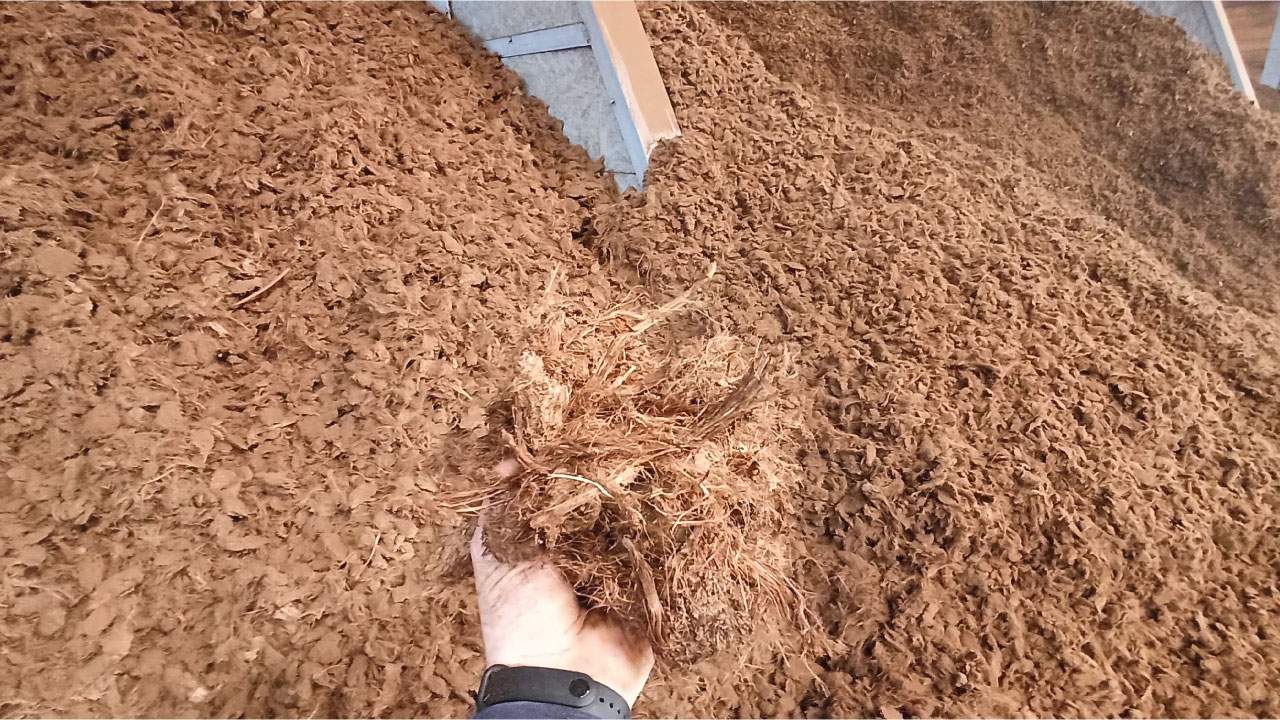
5 big things we’ve still got left to learn about the Baltic Sphagnum peat moss
The peat is an unabandonable substrate in horticultural industry till now, and environmental impact will prove the usage of peat will continue in the sector due to its high demand and need. The most common applied method is the use of transplants in small cell production using peat-based media. Vountless studies have been conducted with peat substrates compared to other growing media. Just some conclusions: “When all media were compared, the peat was found to be the most efficient for plant growth with higher vitamins content, total soluble solids, fruit number per plant, and yield on plant. The potassium ratio was found higher in peat when compared with the other media [1], and it is reported that this higher potassium rate can increase the vitamin C in plants. When a comparison was made between only-peat substrate and peat-perlite and peat-zeolite substrates, the biggest leaf area was determined in seedling growth in only-peat substrate.
Lower nutrient losses. Reduces fertilizer consumption by 30% – 40%
High buffer capacity for nutrients
Peat unlocking minerals. Makes fertilizers and other nutrients more effective by increasing uptake. It improves the cation exchange capacity (CEC) that helps to retain minerals, releasing them over time and preventing the leaching of fertilizers.
In general, approximately 80–90% of a fresh peat sample is composed of water and the remaining of solid material. The solid material has most of the components as organic and only 2–10% as inorganic.
Prevents nutrient loss from leaching and helps the soil absorb and hold nutrients. Increases cation exchange in the soil. Contain significant amount of natural soil conditioners like humic matter. The electrical features of peat moss humates influence known chemical reactions. Both groups of complex organic acids, humic acids and fulvic acids have been proven to be involved in three specific chemical reactions. These reactions are commonly termed: (1) electrostatic (columbic) attraction (2) complex formation or chelation and (3) water bridging. Electrostatic attraction of trace minerals reduces leaching into subsoil. The cation is readily available in the soil environment for transport into the plant roots or exchanged for another metal cation.
Helps feed plants
Contain significant amount of natural soil conditioners like humic matter
Humic substances are the main component of soil and peat organic matter, comprising up to 60 – 70% of content. Humic substances are a general category of naturally occurring, biogenic, heterogeneous organic substances of high molecular weight, and refractory to degradation. They consist of several groups of substances that, depending on their solubility, can be grouped as follows: humin is the humic substances fraction that is insoluble in water at any pH; humic acid is the fraction insoluble in water under acidic conditions (pH < 2), but is soluble at greater pH; and fulvic acid is the fraction soluble in water at all pH values. Humic substances form most of the organic components of soil, peat, and natural waters.
Organic compounds interact with humic substances in a number of different ways. Non–ionic organic compounds partition into insoluble humic substances in soils,
whereas soluble humic substances solubilize non–ionic organics.
Impact of humic substances on metabolic processes in plants
Humic substances have numeric biological effects on plants. The suggestion that HS can have a direct effect on plant metabolism, considers that these substances are taken up into plant tissues. As far as they have a poly-anionic (acid) nature, HS could simply act as surface-active molecules. By decreasing the pH at the surface of the plasma
membranes of root cells, HS may counteract the alkalinization which occurs when NO3- is used as an N source.
The interaction of humic substances with organic substances can change their properties and fate in the environment.
The most important observed impacts are:
1. increased apparent solubility of non–ionic hydrophobic substances;
2. reduced solubility of ionic organic substances;
3. reduced volatility of organic substances;
4. modified chemical reactivity of organic substances in the environment;
5. changes in the rate of organic bio–accumulation in the environment;
6. increased association of organic substances with sedimentary phases and
particulate matter
The functions of HS in the soil environment (such as pH–buffering, binding of clay particles, serving as a reservoir for various micro– nutrient metal ions, sequestration and transport of metal ions, retaining moisture, etc.)are less specific than those in biological systems. In fact, the general functions of HS
in the soil could, in principle, be satisfied by many of the direct, unaltered products of living cells such as proteins, poly–saccharides, or poly–nucleotides. The molecularheterogeneity that is characteristic of HS serves a vital role in the ecological system.
Humic substances constitute the only natural organic material that can survive in bulk and still possess the requisite chemical reactivity to perform the various functions for sustaining soil quality and promoting plant growth.
Restricts Algae and fungal growth
“If you have mold, use sterilized media”. This is recommendation from professional growers.
Quality Baltic peat moss is free of impurities and do not contain pathogens. In order to use it, there is no need to sterilize the peat or otherwise chemically process (like fumigation) it before use.
In most cases, the appearance of mold is the result of improper storage, and not an event caused by the peat itself.
Promotes the growth of beneficial bacteria
Sphagnum peat moss contains many microorganisms, including Bacillus, Arthrobacter, Actinomyces, Streptomyces, Penicillium, Cladosporum, Trichoderma, Mucor, etc.. Of these, Trichoderma and Streptomyces are very effective in suppressing certain root disease organisms due to their antibiotic synthesis. Their presence in Sphagnum mosses has been found to suppress root diseases caused by Fusarium, Rhizoctonia solani, Phythium and Alternaria brassicicola . These beneficial microorganisms competitively suppress the root rot pathogen populations mentioned above, making Sphagnum peat-based growing mixes difficult for root rot organisms to establish. Saprophytic fungi such as Trichoderma and Peziza species compete for nutrients with other, potentially harmful microorganisms. In this way, it would be much more difficult for pathogenic microorganisms such as Pythium and Phytophthora to grow.
High buffer capacity for nutrients
Buffering capacity impacts the ability of plants to use the nutrients supplied by fertilizers.
Plants can only absorb nutrients from the soil moisture. These must be available there in the right composition. A deficiency but also an excess of certain nutritional elements, can lead to plant damage. Most raw materials have an adsorption complex (Cation Exchange Capacity; CEC) on which cations and anions are exchanged. What remains in the soil moisture (= the solution) is available for the plant to absorb. In growing media, this mainly involves the binding of cations (H+, K+, NH4+, Ca2+, Mg2+, Na+, Fe2+, Mn2+, Zn2+, Cu2+) on the adsorption complex.
Peat have a large adsorption complex which can bind many cations and thus buffer nutrient elements and the pH better. This ensures balance in the pH and nutrition in the solution. The size of the pH buffer is also determined by the type of binding (humic acid, vulvic acid and clay mineral).
Warm temperatures and high rainfall contribute to acidic soil formation because of the significant leaching of base cations (K+, Ca2+, Mg2+, and Na+), followed by the replacement of the base cations with Al3+, Fe2+, and H+ ions at the soil adsorption sites. The pH buffering capacity of highly weathered soils is generally low because of their low pH which negatively impacts soil and crop productivity.
For growers, it is important to closely monitor pH to avoid swings in a growing medium’s pH, which can lead to potential nutrient deficiencies or toxicities.
Pure organic
Sphagnum peat moss from Baltic’s is completely natural and organic material
which indicates that they are approved for use in organic production.
Significant benefits of quality organic peat moss:
• adds body to light and sandy soil
• aerates heavy and sandy soil
• protects the soil from drying out and hardening.
• reduces the possibility of erosion.
• reduces the loss of fertilizer by leaching.
• facilitates hoeing.
• saves water
Conclusion
Container-grown plant substrate mixtures are very important for the production of nursery and greenhouse plants. There have been several studies conducted on horticulture plants with soilless substrate on the parameters such as growth, quality, and quantity. Peat has been used for successful cultivation of dierent vegetables and ornamental crops in soilless culture since the early 1900s. Peat has important functions for plant. It keeps water and nutrients and gives them steadily to plants. It has air pockets or pores to supply oxygen to plant roots and to allow for drainage.